
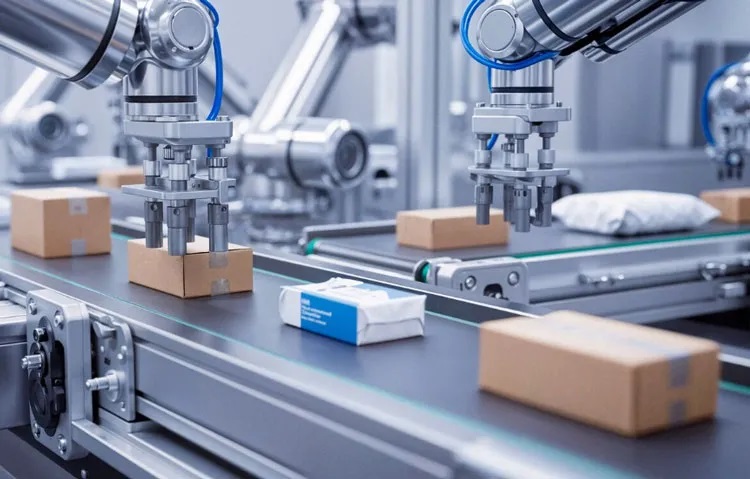
Manufacturing environments that rely on tight tolerances and repeatable output often look for methods that can maintain consistency without slowing production. Rotary systems have become a strong fit for this need, especially when continuous production runs are required. Within that space, precision rotary die cutting services offer a way to produce high volumes of uniform components while maintaining dimensional accuracy across every cycle.
Unlike flatbed processes that operate in a start-and-stop motion, rotary setups use cylindrical tooling that allows materials to move continuously through the cutting system. That steady motion reduces interruptions in production and supports faster throughput. It also helps maintain consistency because the material experiences uniform pressure as it passes through the tooling.
How Rotary Systems Improve Efficiency and Accuracy
The strength of rotary die cutting lies in its balance between speed and precision. Materials are fed through a pressurized system where engraved cylinders shape each piece with consistent force. This setup allows for intricate designs to be reproduced at scale without introducing variation from part to part.
One of the key advantages is reduced handling. Because the material remains in continuous motion, there is less opportunity for misalignment or shifting during production. That stability is especially important for thin or flexible materials that can easily distort under inconsistent pressure.
Precision rotary die cutting services are often chosen when production demands both complexity and volume. Components such as adhesive layers, gaskets, insulation materials, and protective films benefit from this approach because they require accuracy without sacrificing speed. The process supports both simple and highly detailed geometries, making it adaptable across industries with varying technical requirements.
Material Performance and Production Considerations
Material selection plays a central role in how rotary die cutting performs. Softer substrates respond differently to pressure compared to dense or layered materials, which means tooling must be carefully designed to match the material’s behavior during cutting. If the balance between pressure and material resistance is off, edge quality and dimensional accuracy can be affected.
In practice, production teams often fine-tune several variables, including feed rate, pressure settings, and tooling alignment. These adjustments ensure that each material behaves predictably throughout the process. When properly managed, rotary systems can maintain consistent output even across long production runs.
Within this type of environment, Pepin Manufacturing works with an approach that emphasizes alignment between material behavior and production design. That focus helps ensure that components perform as expected once they move into final assembly, rather than requiring downstream corrections or adjustments.
Scaling Production Without Sacrificing Consistency
Scalability is one of the main reasons manufacturers turn to rotary die cutting systems. Once tooling is established, production can continue at high speed with minimal variation between parts. This makes it easier to move from prototype runs to full-scale manufacturing without major process changes.
Precision rotary die cutting services are especially valuable in industries where demand can shift quickly. Being able to scale output without redesigning the production system allows manufacturers to respond to changing requirements without delays. It also helps reduce waste, since consistent cuts mean fewer rejected parts and less material loss over time.
Another important factor in scaling is repeatability. Once a system is calibrated, it can maintain output quality over extended periods with proper maintenance. This reliability supports long production cycles where downtime would otherwise become costly.
Quality Control and Long-Term Manufacturing Stability
Quality in rotary die cutting is not only about the initial setup but also about maintaining performance over time. Tool wear, material variation, and machine calibration all influence the final output. Regular monitoring helps ensure that small changes do not accumulate into larger inconsistencies.
In structured production environments, quality control often includes routine inspection of tooling and sample testing throughout runs. These steps help maintain uniformity and reduce the likelihood of defects reaching later stages of assembly. Over time, this consistency supports stronger product reliability and better overall system efficiency.
Pepin Manufacturing places emphasis on maintaining stable production conditions that support repeatable outcomes. That stability becomes especially important when parts must meet strict functional requirements across multiple production batches.
A Practical Approach to Precision Manufacturing
Rotary die cutting continues to be a practical solution for manufacturers balancing precision with efficiency. The ability to produce detailed, high-volume components in a controlled and repeatable way makes it a reliable choice across a wide range of applications. When paired with thoughtful material selection and controlled production processes, it supports both short-term production needs and long-term scalability.
As demand for consistency increases across industries, precision rotary die cutting services remain a key part of modern manufacturing systems. They provide the structure needed to maintain accuracy while still allowing flexibility in design and production planning.
In this context, Pepin Manufacturing contributes to a process-driven approach that connects design intent with production reality. That alignment helps ensure that each stage of manufacturing supports the next, resulting in components that perform reliably from the first run to full-scale production.