
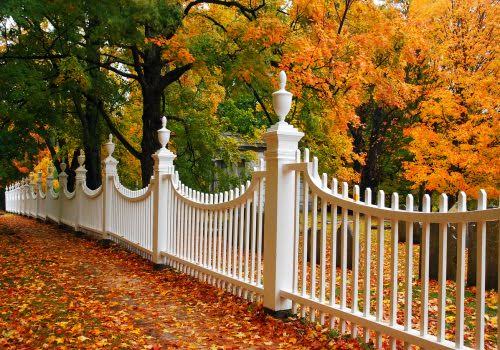
After a long, hot summer, the first spell of proper autumn rain can expose problems that have been developing quietly for months. That is particularly true of garden fencing, where timber, fixings, posts and the ground supporting them have all spent the summer reacting to unusually dry conditions. A fence that looked perfectly respectable in August can behave rather differently after several weeks of rain.
The change matters more than either condition on its own.
Timber gets wet every year. Ground dries every summer. Neither is remarkable.
What causes trouble is repeated movement, especially where the fence already has a weakness.
And after the UK’s record-breaking summer of 2026, I would be paying particular attention this autumn.
Timber never really stops moving
One of the mistakes people make with timber fencing is thinking of it as a fixed, manufactured material.
It isn’t.
Timber takes on and loses moisture according to the conditions around it. As it dries, it contracts. When moisture returns, it expands again.
Good fencing construction allows for that.
Problems start when boards have been fitted too tightly, poor-quality timber has been used, fixings are inadequate or components are already beginning to deteriorate.
After prolonged hot weather, small gaps between boards may become more noticeable. Feather edge boards can move slightly. Rails can dry. Minor splits can open around fixings.
Then autumn arrives.
Moisture returns and the process begins moving in the opposite direction.
Most properly installed fencing will cope perfectly well with this seasonal cycle. Timber has been doing it for considerably longer than any of us have been building fences.
But seasonal movement is very good at exposing shortcuts.
A wet fence is considerably heavier than a dry one
This is easy to overlook.
After persistent autumn rain, timber absorbs moisture and becomes heavier. Add wet vegetation leaning against the boundary and the load can increase further.
That extra weight has to be supported by something.
Usually the posts.
If the posts are sound and properly installed, there shouldn’t be a problem. If one is already weakened by rot or movement, the additional load can help turn a small defect into an obvious one.
I often think people concentrate too much on panels because panels are what they see.
The posts are what I want to know about.
A decent panel between poor posts is still a poor fence.
The vulnerable bit may be almost invisible
Timber posts deserve particular attention at ground level.
A common failure occurs around the point where the post enters the soil or concrete. Conditions there are particularly awkward because moisture levels repeatedly change.
The top of a post may remain relatively dry and look perfectly sound.
The section buried deeper underground may also be preserved differently.
Around ground level, however, timber can spend years cycling between wet and dry conditions.
Eventually deterioration takes hold.
This is why a timber post can look reasonably healthy until somebody gives the fence a push and discovers considerable movement at the base.
Sometimes the deterioration is severe enough that the post effectively has a hinge where solid timber ought to be.
No amount of treating the visible upper section fixes that.
Summer can affect the ground as much as the fence
The record heat matters for another reason.
Soil changes with moisture content.
This is particularly noticeable in clay-rich ground, where prolonged dry periods can cause substantial shrinkage. Cracks appear in lawns and borders, and the ground around existing concrete footings can change.
Parts of Yorkshire are no stranger to heavy ground.
After an exceptionally dry period, I would therefore look around fence posts for evidence that soil has pulled away from the footing or that the post has developed movement.
Then comes the next stage.
Rain.
As moisture returns, the ground changes again. Dry soil begins taking on water and previously hard areas soften.
That doesn’t mean every fence post suddenly becomes unstable when it rains.
Far from it.
Properly installed posts are meant to withstand changing ground conditions.
But if a footing was marginal to begin with, seasonal movement has a way of revealing it.
I’ve removed failed fencing where the amount of concrete around a post was astonishingly small. I’ve also seen plenty of substantial-looking lumps of concrete that weren’t actually deep enough to provide the support required.
You can’t see any of that when the fence is finished.
It looks straight.
That’s why I judge fencing rather differently after it has survived several winters.
Rain doesn’t usually cause the original failure
This distinction matters.
If a fence begins leaning after three days of heavy rain, it is tempting to say the rain damaged it.
Perhaps.
More often, the weather has exposed something that was already wrong.
The post might have been deteriorating for years.
A footing may have been inadequate since installation.
A rail could have been slowly pulling away.
A fixing might already have corroded or loosened.
The soil may have been moving through several seasons.
The rain is simply when the problem becomes visible.
The same applies to storms.
People often say a storm “destroyed” a fence. Sometimes that is literally true – sufficiently extreme winds can damage perfectly good fencing.
But I’ve attended enough damaged boundaries to know that storms are excellent inspectors.
They find the weakest post.
Watch what happens to the rails
Posts aren’t the only components worth checking.
On closeboard and feather edge fencing, horizontal rails transfer loads between the boards and posts. If they are beginning to split or their connections are failing, autumn weather can make the problem more apparent.
Look at where rails meet posts.
Are the fixings still secure?
Has the timber split around them?
Is the rail pulling away?
Does one section move independently of the rest?
Small details tell you a great deal.
With panel fencing, check how the panels sit between posts. A panel that has suddenly become loose may not have changed itself. One of the posts could have moved enough to create additional clearance.
Again, diagnose before replacing.
Throwing a new panel into a structurally unstable section achieves very little.
Heavy vegetation becomes a different problem in autumn
There is a climbing plant on almost every other old fence I seem to look at.
Most cause no serious problem.
Some practically become part of the structure.
I like mature gardens, but I don’t like seeing large amounts of vegetation depending entirely on fence panels for support.
Summer growth can already be heavy. Saturate it with autumn rain and it becomes heavier.
Then add wind.
That combination can place significant force on an older boundary.
Dense vegetation also catches wind, particularly once it has grown through and around boards.
If you have ivy, climbing roses or other established plants covering the fence, look behind them where possible.
Check the rails.
Check the posts.
Make sure the plant hasn’t concealed deterioration.
Cutting everything down isn’t the answer. Sensible management usually is.
Concrete components don’t make the entire fence immune
Concrete posts and gravel boards solve some of the vulnerabilities associated with timber being in contact with the ground.
They don’t solve every fencing problem.
Concrete posts can move if their footings move. They can crack. Panels can deteriorate between them. Poor installation remains poor installation regardless of the material used.
Concrete gravel boards also add weight.
That’s perfectly manageable where the supporting structure has been designed for it, but adding heavy components to already unstable posts is not a clever repair strategy.
Materials need to work as a system.
That applies equally to modern composite fencing. Choosing a lower-maintenance material can remove some of the issues associated with timber boards, but it doesn’t repeal the laws of physics underneath the ground.
Posts still need to be appropriate.
Footings still matter.
Wind still exists.
Exposed boundaries will reveal weaknesses first
Two identical fences can have very different lives.
Put one in a sheltered garden surrounded by buildings and mature hedges.
Put the other at the edge of a development overlooking open ground.
Come back ten years later.
I wouldn’t expect them to have experienced the same loads.
This is relevant around Barnsley because the area contains a real mixture of environments. There are tightly packed residential streets, newer estates, villages, elevated plots and properties sitting close to much more open land.
Exposure needs to influence how a fence is specified.
Tall solid fencing catches a lot of wind. There is no mystery involved. The larger the solid area presented to the wind, the greater the forces that ultimately have to be resisted by the structure supporting it.
Buildings can make the situation less predictable too.
A relatively sheltered garden can contain one boundary section that gets hammered because wind is funnelled through a gap between houses.
If the same panel or post repeatedly fails, stop treating it as coincidence.
There is probably a reason.
Don’t replace what can sensibly be repaired
Autumn also tends to produce unnecessary replacement quotes.
One failed post does not automatically mean an entire boundary needs replacing.
If the remaining structure is sound, targeted fence repairs can be perfectly sensible. A post can fail while neighbouring components still have years of useful life remaining.
I would rather repair good fencing than throw it away.
There is a limit, though.
If several posts of the same age are deteriorating, rails are failing and panels are approaching the end of their useful life, repairing one component after another can become false economy.
This is where experience matters more than a blanket rule.
You need to establish whether you’re dealing with an isolated failure or a pattern.
An isolated failure can often be fixed.
A pattern tells you something about the condition of the whole structure.
Give the fence ten minutes after the next heavy rain
You don’t need to wait for something to fall over.
After the next sustained spell of autumn rain, walk around the boundary.
Look along the fence line.
Check whether posts remain vertical.
Push them gently and watch for movement at ground level.
Open and close the gates.
Look at the rails.
Check whether panels have developed unusual gaps.
Move dense vegetation aside where it is safe to do so.
You’re not carrying out a structural survey. You’re looking for changes.
A gate that suddenly stops latching is a change.
A post that didn’t move in July but moves now is a change.
A rail separating from a post is a change.
Those clues are far more useful than whether the fence looks old.
Autumn doesn’t automatically destroy fencing, just as summer heat doesn’t automatically damage it. A well-built fence should cope with both.
What the transition from one extreme to another does exceptionally well is reveal the parts that weren’t as sound as they looked.
And I’d much rather find a weak post after an afternoon of rain than have a Yorkshire gale find it for me.